
AI SEO
Best AI Tools for Content Creation in 2026 (Tested for SEO, Blogs & Marketing)
A practical guide to the best AI tools for content creation in 2026, with SEO, blog, social media, and marketing workflow use cases.
14 May 2026

The best AI tools for content creation in 2026 are not just writing apps. The strongest tools help marketers research topics, plan search intent, draft useful content, repurpose ideas, maintain brand voice, and publish faster without lowering quality.
For SEO and marketing teams, the right question is not “which AI tool writes the most words?” It is “which tool improves the content system?” A good AI workflow should support strategy, evidence, structure, editing, and distribution.
Quick Answer: The Best AI Content Creation Tools in 2026
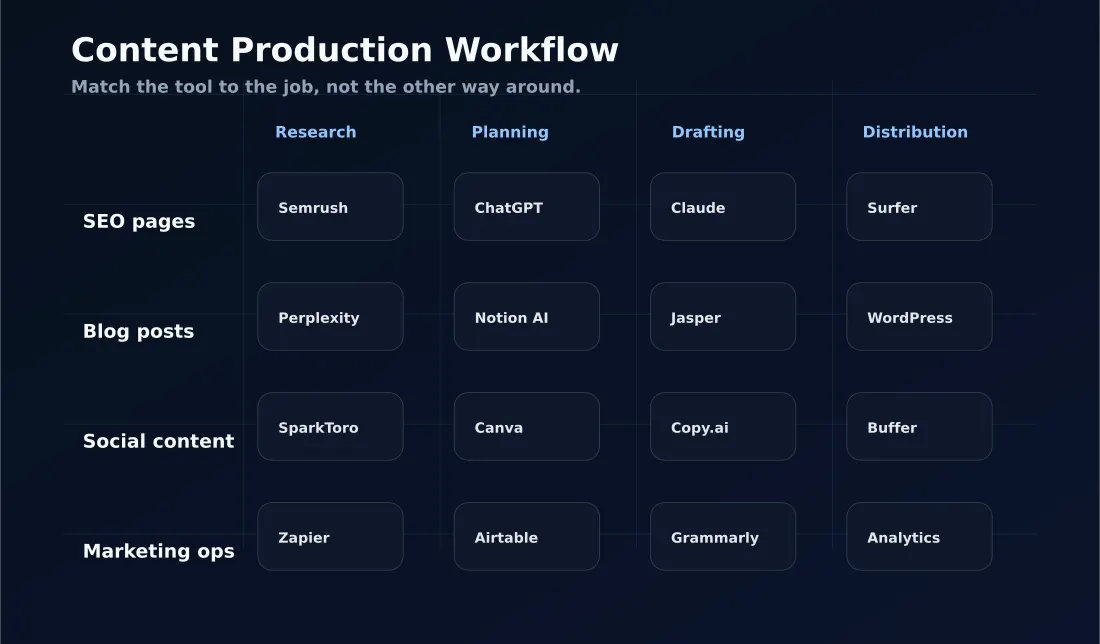
For most businesses, the best AI content stack includes a general reasoning tool, an SEO research tool, a writing assistant, a design or repurposing tool, and a workflow tool. No single platform does everything well.
- Best overall strategic assistant: ChatGPT
- Best for long-form drafting and editorial refinement: Claude
- Best for answer research and source discovery: Perplexity
- Best for SEO briefs and on-page optimisation: Surfer SEO or Clearscope
- Best for marketing copy workflows: Jasper or Copy.ai
- Best for content design and social repurposing: Canva
- Best for editing and clarity: Grammarly
- Best for workflow automation: Zapier, Make, or Airtable
How to Choose AI Tools for SEO Content Creation
A practical SEO content workflow needs more than a text generator. It needs topic validation, audience insight, search intent mapping, entity coverage, internal linking decisions, human editing, and publishing discipline.
1. Start With Search Intent
Before choosing a tool, define the job the content must perform. A blog post targeting an informational keyword needs a different process from a service page, comparison page, social media sequence, or email campaign.
2. Separate Research From Writing
AI writing tools can sound confident even when the source material is weak. Use dedicated research tools such as Perplexity, Semrush, Ahrefs, Google Search Console, or SERP analysis before asking a model to draft content.
3. Keep Human Editing in the Process
AI can speed up structure, ideation, summarisation, and first drafts. It should not replace expert review. The best content still needs real examples, original opinion, fact checking, local context, and clear editorial judgement.
Best AI Tools for Content Creation by Use Case
ChatGPT: Best for Strategy, Briefs, and Content Systems
ChatGPT is one of the most flexible tools for content planning, SEO brief creation, persona development, content refreshes, and marketing workflow design. It works best when you give it clear inputs: audience, search intent, business offer, competitors, brand voice, and desired format.
Claude: Best for Long-Form Drafting and Editorial Quality
Claude is strong for long-form content, rewriting, tone control, and turning rough notes into polished articles. It is especially useful when you need to refine structure, improve clarity, or reshape a draft without making it feel robotic.
Perplexity: Best for Research and Source Discovery
Perplexity is useful for fast research, topic exploration, and understanding how a subject is being discussed across the web. For SEO, it can help identify common questions, source angles, and topical gaps, but every claim should still be verified before publishing.
Surfer SEO and Clearscope: Best for SEO Briefs and Content Optimisation
Tools like Surfer SEO and Clearscope help compare your content against ranking pages, related terms, topical coverage, and structure. They are useful for briefs and refreshes, but they should guide editorial decisions rather than dictate every sentence.
Jasper and Copy.ai: Best for Marketing Copy Workflows
Jasper and Copy.ai are useful for repeatable marketing copy tasks such as ad angles, product descriptions, social captions, email drafts, and campaign variations. They are strongest when paired with a clear offer, messaging framework, and brand examples.
Canva: Best for Visual Content and Repurposing
Canva is useful for turning written content into social graphics, carousels, presentations, and simple visual assets. For content teams, this matters because one strong article can become multiple distribution assets.
Grammarly: Best for Editing and Readability
Grammarly is not a strategy tool, but it is useful for polishing drafts, improving readability, and catching grammar issues before publishing. It fits well at the end of the workflow.
Recommended AI Content Stack for SEO and Marketing
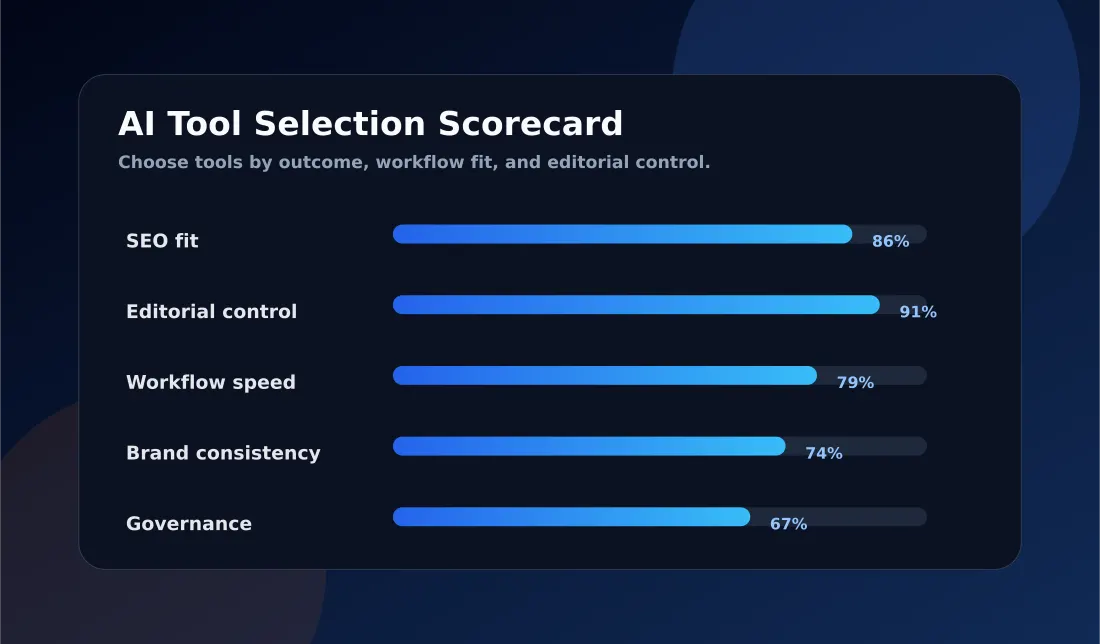
For most small businesses and marketing teams, a lean stack is better than a large stack. Too many tools create confusion, duplicate work, and inconsistent content.
- Use ChatGPT or Claude for strategy, outlines, and drafting.
- Use Perplexity and SEO tools for research and evidence.
- Use Surfer SEO, Clearscope, Semrush, or Ahrefs for SEO validation.
- Use Canva for social and visual repurposing.
- Use Grammarly or a human editor for final polish.
- Use Airtable, Notion, Zapier, or Make to manage the workflow.
What AI Content Tools Still Cannot Do Well
AI tools are powerful, but they do not automatically create trustworthy content. They can miss local context, misunderstand brand positioning, invent facts, overuse generic phrasing, and produce content that looks complete but lacks experience.
This is especially important for SEO. Google rewards content that satisfies the searcher, demonstrates experience, and helps users make decisions. AI-assisted content still needs expert review, unique insight, and a clear reason to exist.
SEO Checklist Before Publishing AI-Assisted Content
- Confirm the primary keyword and search intent.
- Review the live SERP and identify the page type Google is rewarding.
- Add original examples, business context, or expert commentary.
- Use one clear H1 and logical H2/H3 structure.
- Write a concise title tag and meta description.
- Add internal links to relevant service pages or supporting articles.
- Check facts, dates, tool features, and pricing before publishing.
- Add descriptive image alt text and compress visuals.
- Review the content for repetition, generic claims, and unsupported statements.
Final Recommendation
The best AI tools for content creation are the tools that improve your workflow without removing strategy. Use AI for research support, content structure, first drafts, repurposing, and editing, but keep human judgement in charge of positioning, accuracy, and final quality.
For businesses that want SEO results, the winning approach is not simply publishing more AI content. It is building a content system that connects keyword demand, topical authority, internal links, conversion paths, and ongoing optimisation.
If you are planning a wider AI search visibility strategy, see the AI SEO Brisbane service page for how this fits into Google Search, AI Overviews, ChatGPT, Perplexity, and entity-driven SEO.
For work on search foundations and answer-led discovery, explore our AI SEO services.